

React Native vs. Flutter in 2026: An Honest Comparison After Both Frameworks Rebuilt Themselves
An updated 2026 comparison of React Native and Flutter: the New Architecture and React Foundation, Impeller and Flutter 3.44, performance, hiring, web and desktop support, and a practical guide to choosing between them.
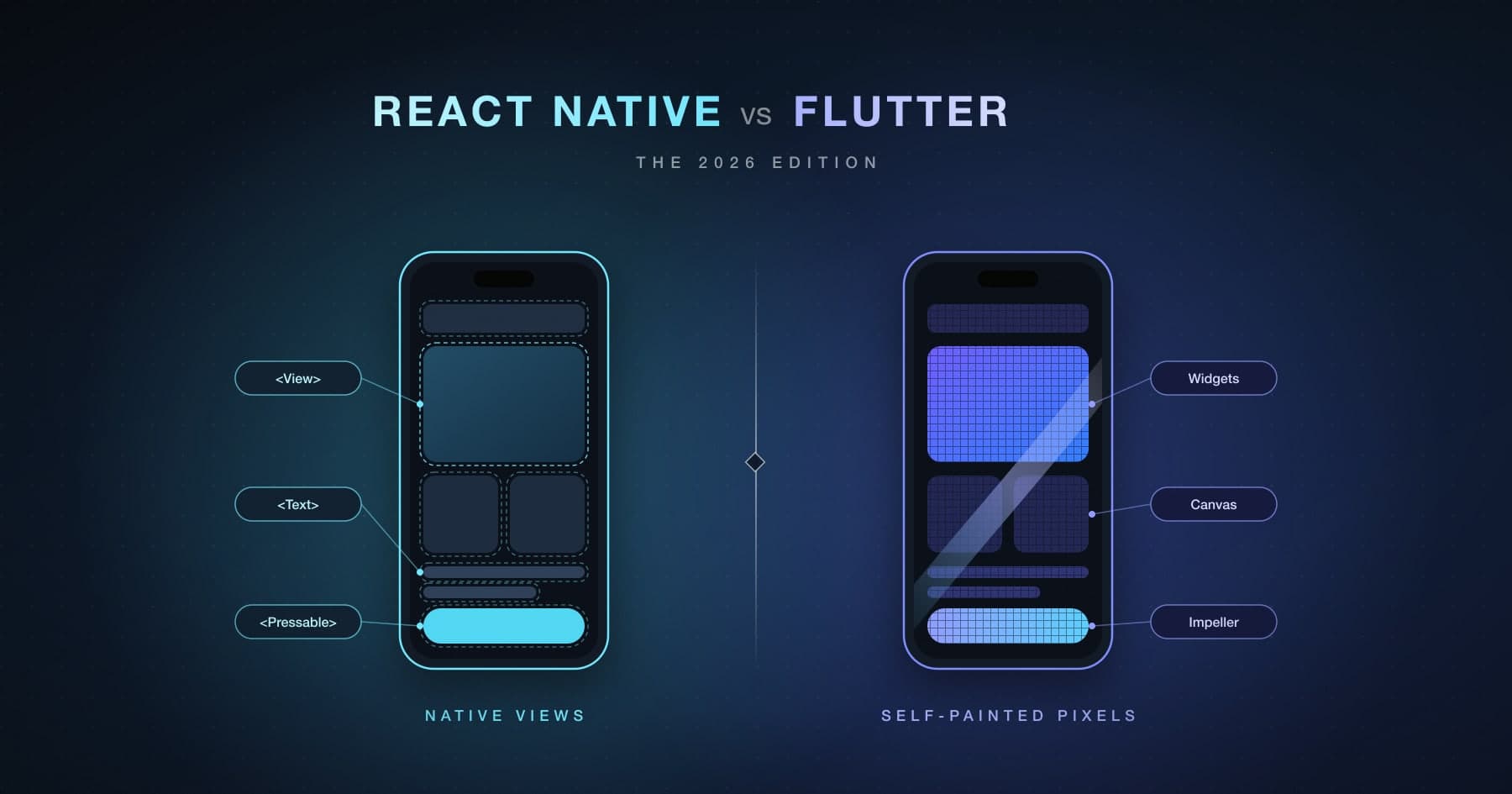
We first published this comparison in January 2024. So much has changed since then that we rewrote it from scratch in September 2026.
When we compared React Native and Flutter in early 2024, the debate followed a familiar script. React Native had the JavaScript ecosystem and a performance asterisk. Flutter had speed, pixel-perfect consistency, and a language most developers had never used.
That script is out of date. In the past two years, both frameworks have replaced their foundations. React Native finished a multi-year architectural rewrite and moved to independent governance. Flutter made its own rendering engine the default and started pulling its design libraries out of the core. The old talking points no longer describe either framework accurately.
Here is where they stand now, from a team that ships React Native in production and chooses native code when a product demands it.
What Changed in React Native
React Native's "New Architecture" was years in the making. Between mid-2025 and mid-2026 it stopped being a migration and became the only way the framework works:
- June 2025 (0.80): The legacy architecture was officially frozen.
- October 2025 (0.82): React Native ran entirely on the New Architecture, and the legacy system was removed from the runtime. The old asynchronous "bridge" between JavaScript and native code, long blamed for performance problems, is gone.
- December 2025 (0.83): React 19.2 support arrived in the first release with no user-facing breaking changes.
- February 2026 (0.84): Hermes V1 became the default JavaScript engine, and iOS builds began using precompiled binaries by default.
- April 2026 (0.85): A new animation backend, built with Software Mansion, made it possible to animate layout properties on the native thread.
- August 2026 (0.87): The stricter TypeScript API became the default, experimental Swift Package Manager support arrived, and minimum requirements rose to Node.js 22, Android Gradle Plugin 9, and Kotlin 2.0.
The governance change may matter even more over the long term. In October 2025, Meta announced it would move React and React Native to the new React Foundation under the Linux Foundation. Its founding members include Amazon, Callstack, Expo, Huawei, Meta, Microsoft, Software Mansion, and Vercel. React Native is no longer a project that depends on one company's priorities.
Expo, the most popular toolkit for building React Native apps, has kept pace. Expo SDK 57, released at the end of June 2026, ships with React Native 0.86.
What Changed in Flutter
Flutter's changes are less about architecture than about maturity and modularity:
- Impeller everywhere. Flutter draws its own interface rather than using the platform's controls. Impeller, the rendering engine built to eliminate the stutter of compiling graphics shaders at runtime, is now the only renderer on iOS and the default on Android 10 and newer.
- Flutter 3.44 (May 2026), released with Dart 3.12 at Google I/O, made Swift Package Manager the default for iOS and macOS dependencies, replacing CocoaPods. It also froze the Material and Cupertino design libraries in the core framework ahead of their move into standalone packages, and introduced an opt-in rendering mode for Android, Hybrid Composition++, that improves how native views are embedded.
- AI-assisted development is now first-party. Flutter's official tooling includes an MCP server that lets AI coding agents find a running app and trigger hot reload after making changes, which Google calls "agentic hot reload." Its GenUI package lets AI models generate interface components at runtime.
- A predictable release train. Flutter ships a stable release roughly every quarter: 3.41 in February, 3.44 in May, and 3.47 in August 2026, with 3.50 planned for November.
Flutter's reach beyond phones keeps growing. Google's launch post for 3.44 highlighted Toyota's 2026 RAV4, whose multimedia system runs on Flutter, and an upcoming SDK for LG's webOS smart TVs.
The Difference That Still Matters Most
Two years of change haven't altered the fundamental split between the frameworks. It is how they put pixels on the screen.
React Native uses the platform's own views. Your TypeScript describes the interface, and React Native creates real iOS and Android views to display it. Where your app uses native controls such as navigation bars, switches, pickers, and system tabs, it gets the platform's own behavior, accessibility, and look, and it picks up the platform's design changes along with the operating system.
Flutter paints everything itself. Your Dart code builds a tree of widgets, and Flutter's engine draws every pixel directly. The result looks and behaves identically on every device, which is exactly what brand-driven, highly custom designs want. The cost is that platform-style controls are re-creations. When Apple or Google redesigns its system controls, Flutter apps look the same until the framework's widgets, or your own, are updated to match.
Neither approach is better in the abstract. The right choice depends on whether your product should feel like part of the platform or like itself everywhere.
Side by Side in 2026
| React Native | Flutter | |
|---|---|---|
| Language | TypeScript / JavaScript | Dart |
| Rendering | Native platform views | Self-rendered with Impeller |
| Governance | React Foundation (Linux Foundation) | |
| Release rhythm | About every two months | About every quarter |
| Web | Via React Native Web and Expo | First-party, with WebAssembly support |
| Desktop | Windows and macOS via Microsoft-maintained projects | First-party Windows, macOS, and Linux |
| iOS dependencies | CocoaPods, with experimental Swift Package Manager | Swift Package Manager by default |
| Official AI tooling | Community and vendor tools | First-party MCP server and agent skills |
| Best fit | Platform-native feel, teams with web skills, code shared with web | Custom, brand-led design, identical UI everywhere, embedded screens |
Performance: Mostly a Settled Question
For typical business apps with forms, lists, feeds, and dashboards, users can't tell the frameworks apart in 2026. React Native's New Architecture removed the bottleneck that earned it a reputation for sluggishness, and Flutter's Impeller removed the shader-compilation jank that used to haunt its first frames.
Differences remain at the extremes. Flutter still has an edge for interfaces built around heavy custom graphics and continuous animation, because it controls the whole rendering pipeline. React Native tends to integrate more naturally when an app leans heavily on native platform components or embeds complex native views.
Our advice: unless your app is a game-like, animation-heavy experience, don't choose on performance. Choose on people and platforms.
Ecosystem, Hiring, and Popularity
Popularity figures are harder to pin down than they used to be. In the 2024 Stack Overflow Developer Survey, the last to list the two side by side, 9.4 percent of respondents reported using Flutter and 8.4 percent React Native. The 2025 survey reorganized its categories and no longer offers a clean comparison. On GitHub, Flutter had roughly 178,000 stars in July 2026 against React Native's 126,000, though stars measure interest more than production use.
Hiring tells a clearer story. JavaScript and TypeScript are among the most widely used languages in software, and any strong React web developer can become productive in React Native quickly. Dart developers are growing in number but remain much scarcer. For a company that needs to staff a team, or share engineers between web and mobile, that difference is often decisive.
Web and Desktop
Flutter offers first-party web and desktop support from one toolkit, which makes it attractive for internal tools, kiosks, and app-like experiences that must run everywhere. Because Flutter web draws to a canvas, it suits interactive applications better than text-heavy, search-driven websites.
React Native reaches the web through React Native Web, which renders components as ordinary HTML. That is how our own Calc Pro web calculator works: the same components that run on iPhone, iPad, Mac, and Android render in the browser. We describe what that took, including the browser-specific problems it surfaced, in One Codebase, Every Screen. On desktop, Microsoft maintains React Native for Windows and macOS.
What We Chose, and Why
We don't have a favorite framework. We have products with different needs.
For Calc Pro, we chose React Native. The app's value is a large, heavily tested calculation engine written in TypeScript. React Native let us share that engine, and most of the interface, across iPhone, iPad, Mac, Android, and the web. The web target was decisive: React Native Web let us offer the full calculator free in a browser without maintaining a separate web app.
For Metronome, we chose neither. We rewrote it in native Swift, because sample-accurate audio timing, background playback, and Apple Watch haptics are the whole product. A cross-platform framework would have drawn the screens while the parts that matter were written natively anyway. The full story is in Building a Metronome That Keeps Perfect Time.
How to Choose
Choose React Native if:
- Your team knows React, JavaScript, or TypeScript, or you plan to hire from that large pool.
- You want to share code or people with a web product.
- Your app should look and behave like a native iOS and Android app.
- You value independent, multi-company governance.
Choose Flutter if:
- Your design is highly custom and must look identical on every device.
- Your UI is animation-heavy or graphics-driven.
- You need first-party desktop, embedded, or TV targets from one toolkit.
- Your team is comfortable with Dart, or willing to learn it.
Choose native Swift and Kotlin if:
- The product depends on deep hardware or operating-system integration, such as audio, camera, sensors, or wearables.
- You need the newest platform features the day they ship.
- Performance or battery life is the product.
The Verdict
In 2024 we called this contest close. In 2026 it is closer still. Both frameworks have fixed the weaknesses their critics loved to cite, and both are fully capable of powering serious, high-traffic apps. The decision is no longer about which framework is "better." It is about which one fits your team, your design, and the platforms you need to reach.
If we had to generalize, we would say React Native is the pragmatic default for most businesses, especially those with web teams or web products. Flutter is the stronger choice for design-led products that must look identical everywhere and for companies targeting screens beyond phones. And sometimes the honest answer is neither.
Whatever you choose, budget for what comes after launch. Both frameworks now release several times a year, and keeping current is part of the cost of owning an app. Our app cost guide covers what that looks like in practice.
Not sure which approach fits your project? At Panoramic Software, we build cross-platform and native apps and will recommend what is right for your product, not what is fashionable. Let's talk.
Sources
- React Native blog: 0.82, 0.85, and 0.87 release notes
- Engineering at Meta: Introducing the React Foundation
- Expo: SDK 57 changelog
- Flutter blog: What's new in Flutter 3.44
- Flutter docs: Impeller rendering engine and release schedule
- Droids On Roids: Flutter vs. React Native in 2026
 Calc ProUnlimited
The gold standard for mobile calculation is now available in your browser. Ten professional calculators, zero compromises.